


Until The Next Heat Wave (Part 1)
Updated: Aug 4

This article is the first in GBCE’s August series on heat waves and the built environment. Over the coming weeks, we will examine how extreme heat is reshaping cities, buildings, infrastructure, and public health, and what this means for developers, asset owners, policymakers, and investors.
Series overview
A building designed using historical climate data from the 1990s may still be operating in the 2060s, meaning many assets are being designed for a climate that no longer exists.
Extreme heat is no longer simply a summer weather event. It is becoming a systemic risk that affects public health, labour productivity, energy infrastructure, water systems, and building sector performance.
In July 2025, parts of Southern Europe recorded temperatures above 45°C, while several cities experienced nighttime temperatures above 30°C, conditions that significantly increase the risk of heat-related illness because the human body cannot adequately recover after sunset. Similar patterns have emerged across India, Thailand, and China, where heat waves are arriving earlier in the year and lasting longer than historical averages.
The World Meteorological Organization confirmed that 2024 was the warmest year on record globally, continuing a decade of unprecedented temperatures. Climate scientists now expect heat waves to become more frequent, longer, and more intense as global temperatures rise. Source: WMO, State of the Global Climate 2024
What Has Changed?
The key change is not just higher average temperatures. The entire probability distribution of heat extremes is shifting.
The IPCC has concluded that hot extremes that previously occurred once every fifty years are already becoming substantially more frequent in many regions because of human-induced climate change. In practice, this means that infrastructure, buildings, and public-health systems designed using historical climate data are increasingly operating outside the conditions for which they were originally planned. Source: IPCC Sixth Assessment Report
Warm nights are particularly important. When temperatures remain elevated after sunset, the body's cooling mechanisms become less effective, increasing cardiovascular stress and mortality risk.
The Human Cost Is Already Measurable
The most important consequence of extreme heat is the impact on people.
A study published in Nature Medicine estimated that the 2022 European heat wave was associated with more than 61,000 heat-related deaths across 35 countries. Mortality was highest among older adults, and the risk increased sharply during periods of sustained nighttime heat. Source: Nature Medicine, Heat-related mortality in Europe
In many cities, indoor temperatures can remain dangerously high for days in buildings with poor insulation, inadequate shading, limited ventilation, or heat-absorbing roofs and façades. This is why heat resilience is not only an environmental issue; it is fundamentally a public-health issue.
The burden is also unevenly distributed. Lower-income households are more likely to live in poorly performing buildings and may have limited access to air conditioning or higher exposure to outdoor work.
Heat Is Becoming an Economic Constraint
Extreme heat is increasingly affecting economic productivity.
The International Labour Organization estimates that heat stress could result in the loss of more than two percent of total working hours worldwide by 2030, equivalent to tens of millions of full-time jobs. Construction, logistics, agriculture, and manufacturing are among the sectors with the highest exposure. Source: ILO, Working on a Warmer Planet
For South East Asia, the issue is compounded by humidity. High humidity reduces the body's ability to cool itself through sweating, meaning that workers can reach dangerous heat-stress thresholds even when air temperatures are lower than those seen in drier climates.
This has direct implications for project scheduling, worker safety, insurance, and labour costs.
Why Cities Become Hotter Than Their Surroundings
Urban areas amplify heat through the urban heat island effect.
Dense construction, asphalt surfaces, dark roofs, and limited vegetation absorb solar radiation during the day and release it slowly at night. Surface temperatures on exposed asphalt can exceed 60°C under direct sunlight, and some urban districts can remain several degrees warmer than surrounding rural areas after sunset.
The World Bank's 2025 study on Bangkok identified significant temperature differences between heavily built-up districts and greener areas, highlighting the role of tree cover, shading, and urban design in reducing heat exposure. Source: World Bank, Shaping a Cooler Bangkok
This is not just a comfort issue. Higher urban temperatures increase cooling demand, worsen air quality, and raise health risks for people who rely on walking, cycling, or public transport.
Infrastructure Was Not Designed for This
Heat affects infrastructure in ways that are often overlooked. Electricity demand rises sharply because of air-conditioning use. Power transformers operate less efficiently at high temperatures. Rail systems can face speed restrictions or deformation risks. Airport operations may require adjustments during extreme heat events. Water demand increases while some regions face growing water stress.
The International Energy Agency projects that space cooling will become one of the fastest-growing sources of electricity demand globally, with the largest increases expected in emerging economies. Without major improvements in building efficiency, this could create substantial new peak-load pressure on power networks. Source: IEA, The Future of Cooling
Buildings Are Both Vulnerable and Responsible
Buildings are where most people experience heat, and they are also a major driver of the energy required to respond to it.
According to the Global Status Report for Buildings and Construction 2024-2025, the buildings and construction sector accounted for approximately 32 percent of global energy demand and 34 percent of global energy-related carbon emissions. Rising temperatures are expected to increase cooling demand significantly, particularly in rapidly urbanising economies. Source: UNEP & GlobalABC, Global Status Report for Buildings and Construction 2024-2025
This creates a feedback loop: hotter cities require more cooling, more cooling increases electricity demand, and higher electricity demand can increase emissions if the power supply is not rapidly decarbonised.
A Building Sector Risk, Not a Future Scenario
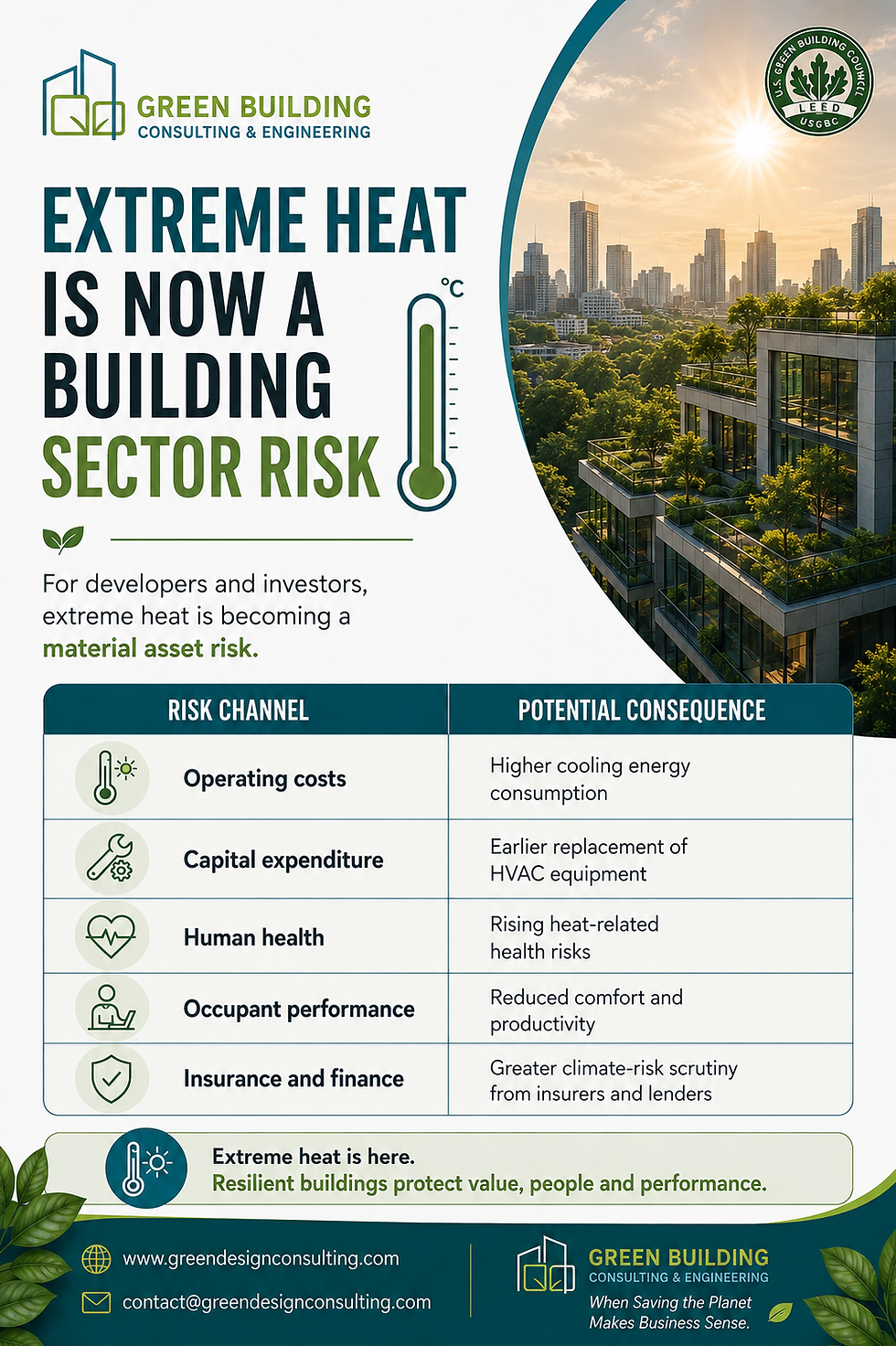
For developers and investors, extreme heat is becoming a material asset risk.
Risk channel | Potential consequence |
Operating costs | Higher cooling energy consumption |
Capital expenditure | Earlier replacement of HVAC equipment |
Human health | Rising heat-related health risks |
Occupant performance | Reduced comfort and productivity |
Insurance and finance | Greater climate-risk scrutiny from insurers and lenders |
Asset value | Potential obsolescence of poorly adapted buildings |
A building completed today is likely to operate through the 2050s and 2060s. Designing only for historical climate conditions means locking in decades of higher operating costs and future retrofit expenses.
The Question Is No Longer Whether to Adapt
The evidence suggests that extreme heat should now be treated as a design condition, not an exceptional event.
The challenge is not simply how to install more air conditioning. Mechanical cooling remains essential, but relying on it alone increases electricity demand, strains infrastructure, and does little to reduce outdoor heat exposure.
The more important question is how to reduce heat before cooling is required, through building orientation, external shading, high-performance envelopes, urban greening, reflective materials, water-sensitive design, and district-scale cooling strategies.
That is the focus of Part 2: Can Our Cities Survive the Next Heat Wave? which examines the engineering and urban-design approaches that can create healthier, lower-energy, and more resilient buildings in a warming climate.
Continue the Series
SOURCES


The template library and conversational editing approach at Design.com are worth examining. The best-ai-logo-generator.com page provides a detailed look at its features, including the free SVG downloads and the $3/mo pricing tier, which is useful for budget-conscious users.
For those focused on the Solana ecosystem, checking SPL tokens before interacting with them is essential given the number of new launches. This SPL token scam analysis resource is designed specifically for that chain, helping you spot honeypot patterns and suspicious contract setups. It's a straightforward way to add a layer of verification to your research process.
Royal Rummy offers a fresh take on a familiar classic, and I wanted to know more before trying it. The overview at https://odds96.com/en/blog/royal-rummy explains the key features clearly and makes the game easy to understand. After reading it, I felt comfortable getting started right away. The interface is modern, navigation is intuitive, and everything works smoothly on both desktop and mobile devices. I also enjoy how responsive the controls feel during every session. The overall design is polished without becoming complicated. It has been a genuinely enjoyable experience from the very beginning.