


Designing Industrial and Warehouse Buildings for Thailand’s Monsoon Reality
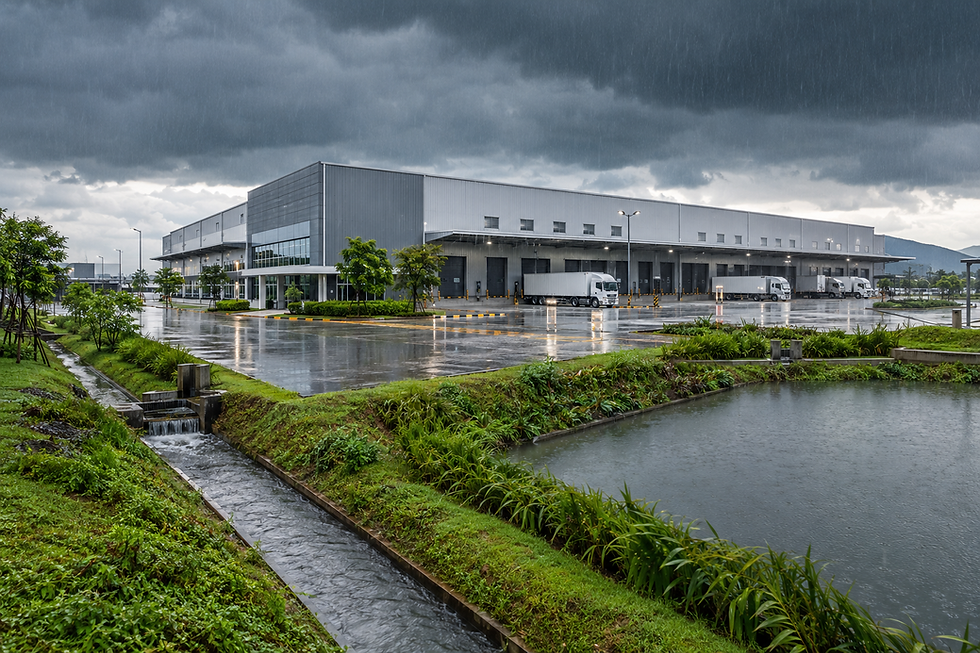
Thailand’s industrial and warehouse sector is expanding rapidly, from logistics centres and distribution hubs to manufacturing facilities and large-scale industrial estates.
But these assets are also exposed to a recurring operational risk: water.
Thailand's monsoon season brings intense rainfall, surface runoff and localised flooding. For industrial and warehouse facilities, the consequences can extend well beyond temporary inconvenience. Floodwater can disrupt access roads, damage equipment and inventory, interrupt utilities, affect employees and stop operations.
The question is therefore not simply whether a site has drainage.
It is whether the site has been designed to manage extreme rainfall and remain operational when conditions exceed normal assumptions.
Designing for Thailand’s Changing Rainfall Risk
Thailand's rainfall is highly seasonal, with the southwest monsoon bringing much of the country's annual precipitation. The Thai Meteorological Department notes that rainfall patterns vary significantly across regions and seasons, while tropical storms can further intensify rainfall during the wet season. Thai Meteorological Department
Climate change adds another layer of uncertainty.
The IPCC reports that heavy precipitation events are projected to become more frequent and intense in many regions as global temperatures rise. For Asia, the IPCC identifies heavy precipitation and flooding among the important climate risks facing communities and infrastructure. IPCC AR6 Asia
For industrial and logistics assets, this means historical rainfall data alone may not provide the full picture of future exposure.
Why warehouses are particularly vulnerable
A warehouse can have a large roof, extensive paved areas, loading docks, parking, access roads and relatively little permeable ground.
That creates a simple problem: A lot of rain can become a lot of runoff very quickly.
During an intense storm, water needs somewhere to go.
If drainage systems, retention areas, culverts or downstream infrastructure cannot handle the volume, water can accumulate on site or flow into buildings. The operational consequences can be significant.
Flooding around loading docks can prevent trucks from entering or leaving. Water entering electrical rooms can interrupt power. Damaged stock can create direct financial losses. Access disruptions can affect employees and suppliers even when the building itself remains dry.
For logistics facilities, the road network can be just as important as the building.
A warehouse that remains operational internally is of limited value if its access route is flooded.
Start with the whole site, not the building
Stormwater resilience should begin during site selection and master planning.
The first question is not:
"What drainage system should we install?"
It is:
"Where does the water come from, where will it go, and what happens when the system is overwhelmed?"

A proper assessment should consider:
01 — Site elevation Is the facility above surrounding ground and known flood levels? 92% of natural-catastrophe losses in Asia were uninsured in the cited Swiss Re analysis, highlighting the financial exposure when physical risk materialises.
02 — Upstream catchments Can runoff from neighbouring land or higher ground enter the site? Heavy precipitation has increased across Asia, and the IPCC projects it to become more frequent and intense with additional warming.
03 — Downstream capacity Can surrounding drains, canals and waterways receive additional runoff? $157B → $535B WRI projects annual urban property damage from riverine flooding to rise threefold by 2050.
04 — Access routes What happens if roads or bridges flood? Flooding can disrupt more than the building itself: access, logistics and business continuity can be affected even when the facility remains physically protected. The IPCC identifies flooding as a major risk to infrastructure in Asia.
05 — Existing flood history Where has water accumulated previously? 132M people and $535B in urban property could be impacted annually by riverine flooding by 2030, according to WRI's Aqueduct Floods analysis.
06 — Future climate exposure Could rainfall intensity or flood risk change over the asset's operating life? 8.11% of 2,134 APAC REIT assets analysed are projected to be high risk by 2050.
THE DESIGN QUESTION
What should change before detailed design begins?
Site levels · Building placement · Drainage routes · Retention capacity · Access routes · Flood protection
Source line: Swiss Re / ADB · WRI Aqueduct Floods · IPCC AR6 · XDI 2024
Design for water, not just against it
A resilient industrial site uses multiple layers of protection.
1. Keep critical areas above the risk
Finished floor levels, electrical equipment, control rooms and other critical infrastructure can be positioned above expected flood levels, with appropriate freeboard.
The objective is simple: Keep water away from the assets that cannot afford to get wet.
2. Give stormwater somewhere to go
Drainage should not rely on a single pipe network.
Depending on the site, solutions can include retention ponds, detention tanks, swales, permeable surfaces, landscaped drainage corridors and controlled discharge.
These approaches can slow runoff, temporarily store water and reduce pressure on downstream drainage infrastructure.
3. Design for exceedance
This is often overlooked. A drainage system is designed for a particular rainfall event. But what happens when rainfall exceeds that design event?
Instead of allowing water to enter the warehouse, the site can be designed with safe overflow routes.
Car parks, landscaped areas or designated low points can become temporary storage areas, while buildings and critical infrastructure remain protected.
This is the principle of planned exceedance: when infrastructure is overwhelmed, water follows a safer path rather than an uncontrolled one.
Nature can be part of the drainage system
Green infrastructure can also play a role.
Vegetated swales, rain gardens, detention landscapes and permeable surfaces can help slow and manage stormwater close to where it falls.
The U.S. Environmental Protection Agency describes green infrastructure as a way of managing stormwater through processes such as infiltration, evapotranspiration and temporary storage. US EPA
For large industrial sites, this can be particularly relevant because the available land area can provide opportunities for integrated stormwater management.
But green infrastructure should not be treated as a substitute for engineered drainage.
The most resilient approach is often a hybrid system, combining conventional drainage with landscape-based retention and controlled overflow.
Flood resilience is also operational resilience
The design should continue beyond the site boundary.
A resilience assessment should identify what happens if:
The main access road floods
Loading docks become inaccessible
Power is interrupted
Backup generators are exposed
Water enters electrical or mechanical rooms
Employees cannot reach the facility
Suppliers cannot deliver
Inventory is damaged
Drainage systems become blocked
This turns flood protection from a civil engineering issue into an operational continuity issue.
For warehouse and industrial operators, the most useful question may therefore be:
"How many hours or days can this facility continue operating during a major storm?"
That question changes the design conversation.
Maintenance is part of resilience as well
Even a well-designed drainage system can fail if it is poorly maintained.
Before and during Thailand's monsoon season, operators should check:
☐ Drains and grates — check for blockages
☐ Pumps — check operational readiness
☐ Retention areas — check available capacity
☐ Culverts and outfalls — check for obstructions
☐ Roof drainage — check for debris
☐ Flood barriers — check accessibility
☐ Emergency power — check critical systems
☐ Water levels — check where monitoring is available
A resilient design therefore needs a resilient operating plan.
The business case
Flood resilience is often discussed as a technical requirement.
It is also a business decision.
The cost of preventive measures can be compared with the potential consequences of disruption: damaged inventory, equipment replacement, lost operating days, emergency repairs, delayed deliveries and impacts on customers.
The World Bank has highlighted the growing economic impacts of flooding in Asia and the importance of investing in resilient infrastructure and risk reduction. World Bank
For industrial and warehouse assets with long operating lives, resilience should therefore be considered alongside energy performance, operational efficiency and maintenance from the beginning.
The goal is not to design a building that can withstand every possible flood.
It is to understand the site's water risks, reduce exposure, protect critical assets and create safe pathways for water when the system is pushed beyond normal conditions.
In Thailand's monsoon climate, stormwater is not simply a drainage problem. It is part of building performance, operational continuity and long-term asset resilience.
How exposed is your asset to climate risks?


Comments