


Can Green Buildings Still Compete When Construction Costs Are Under Pressure?

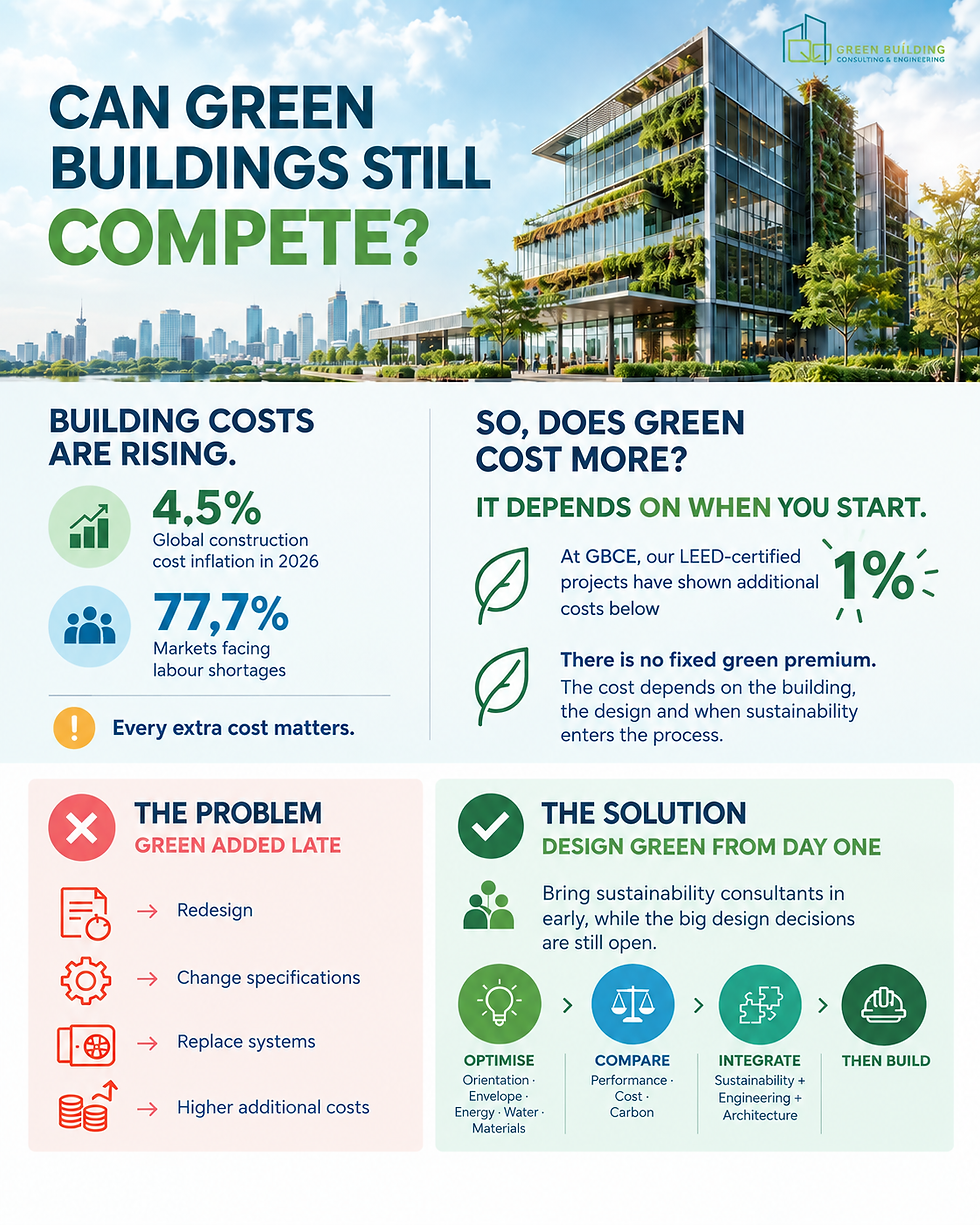
Construction costs are no longer a temporary problem that developers can simply wait out. In 2026, global construction cost inflation is running at about 4.5%, up from 4.2% in 2025, while labour shortages have become a more important source of cost pressure than broad-based material inflation. Turner &
Townsend reports that 77.7% of global markets are experiencing labour shortages or severe labour shortages, with fewer than 6% reporting surplus capacity. In Asia, 10 of 11 markets surveyed say skilled labour shortages are having a large or major impact on construction delivery. (Turner & Townsend, 2026)
That creates an uncomfortable question for developers: when budgets are already under pressure, can sustainable design still compete with conventional construction?
The answer depends on what "green" means.
If sustainability means adding expensive technologies at the end of a project, the economics can be difficult. If it means designing a building that needs less energy, water and mechanical capacity from the beginning, the financial case becomes considerably stronger.
The green premium is often smaller than assumed
The idea that a green building automatically requires a major construction premium does not match the available project data.
Research from the International Finance Corporation's EDGE programme found that incremental capital expenditure for some green buildings can range from 1% to 10%, depending on building type and location. In one Indian affordable housing example, Joyville Shapoorji Housing kept the incremental cost below 1% by concentrating on passive design measures, while achieving energy savings of up to 45%. IFC also cites Tata Realty & Infrastructure reporting incremental costs of approximately 2% for its green residential projects. (IFC, 2023)
The important point is not that every green project will cost only 1% or 2% more. IFC's data shows considerable variation by country, building type and design strategy. Some projects have incremental costs above 10%. (IFC, 2023)
What makes the difference is when sustainability is brought into the project. When sustainability consultants are involved early, they can influence site planning, orientation, façade design, systems, materials and other fundamental design decisions while changes are still relatively easy and cost-effective to make. When sustainability is introduced late in design or during construction, the same objectives can require redesign, specification changes, replacement of already-selected systems or additional work, increasing the cost significantly.
The question is therefore not simply whether green costs more. It is how early sustainability is integrated into the design process, and whether it is used to inform the design rather than added to it afterwards.
A building designed around solar control, insulation, efficient glazing, natural daylight and reduced cooling demand can approach sustainability very differently from a conventional building that later receives expensive equipment and certification requirements.
The real opportunity is reducing the building's operating burden
Construction cost is only one part of the financial equation.
The U.S. Department of Energy estimates that around 30% of energy used in commercial buildings is wasted. That is effectively an operating-cost problem sitting inside the building stock. (U.S. Department of Energy)
Building controls provide a particularly useful example. A U.S. Department of Energy and Pacific Northwest National Laboratory study found that properly implemented commercial building controls could reduce energy consumption by approximately 29% on average across the building types and climate zones studied. Some individual building types had substantially greater potential, including secondary schools at approximately 49%. (U.S. Department of Energy, PNNL)
This changes how the developer should think about sustainability.
The question is not simply whether an efficient HVAC system costs more than a conventional one. The question is how much energy the building will consume every year, how much the equipment will cost to maintain, and whether reducing the cooling or heating load can allow the project to use smaller systems in the first place.
That is where green design can become a cost-control strategy rather than a cost addition.
Payback can be surprisingly short
IFC's project data provides some of the strongest evidence for this argument.
Across a sample of EDGE projects, incremental capital expenditure was generally in the 1% to 10% range, while some residential projects achieved utility-cost payback within two to three years. IFC reports that an Indian affordable housing developer achieved energy savings of up to 45% with less than 1% incremental construction cost. (IFC, 2023)
An earlier IFC case study in Indonesia provides another concrete example. The Citra Maja Raya development reported a 4.7% additional cost, a 1.8-year payback period, and annual utility savings of approximately 30% after incorporating green measures. (IFC)
The revenue side is becoming harder to ignore
There is another reason developers should be cautious about treating sustainability as an optional feature: green performance can affect the income generated by an asset.
World Green Building Council's 2025 Asia Pacific report found that certified green buildings were associated with rental premiums of up to 11%, while reported energy savings ranged from 20% to 60%. The report draws on evidence and case studies from markets including Singapore and Hong Kong. (World Green Building Council, 2025)
IFC's research across emerging markets has also reported potentially significant differences between green and conventional assets. Its analysis found green buildings with operating costs up to 37% lower, occupancy rates up to 23% higher, and sale premiums of up to 31%. These are upper-end findings rather than guaranteed outcomes for individual projects, so they should not be treated as a standard market premium. (IFC)
The direction of the argument is nevertheless significant. Sustainability can potentially affect both sides of the property equation: lower expenses and stronger revenue.
But developers should not greenwash their budgets
This is where the industry needs some discipline.
Not every sustainability measure deserves to survive a value-engineering exercise. A project with an expensive sustainability package but weak energy savings, poor tenant demand and a long payback period is not automatically a better investment.
The smarter approach is to identify measures according to their actual economics.
Passive design should receive particular attention because it can reduce demand before mechanical systems are selected. Efficient envelopes, solar shading, orientation, glazing and controls can influence the size and workload of downstream systems. IFC's EDGE framework itself is built around identifying combinations of energy, water and embodied-energy measures, with certification requiring projected savings of at least 20% in each of those areas compared with a conventional building. (IFC EDGE)
That is a better way to think about green construction under financial pressure: not "How much more does sustainability cost?" but "Which design decisions produce the largest lifetime value per dollar of additional capital?"
The competitive green building will be the efficient one
Construction cost pressure does not make sustainability irrelevant. In some respects, it makes the economic case for efficient buildings more demanding and more useful.
Developers cannot afford to spend blindly. They need measurable energy savings, realistic payback periods, lower operating expenditure and evidence that tenants or investors will value the resulting asset.
The strongest case for green buildings therefore is not that they are inherently cheaper to construct.
The stronger argument is that green design can turn a portion of upfront construction spending into a long-term operating advantage.
That distinction matters when construction costs are rising. A developer who focuses only on the cheapest possible construction may minimise today's capital expenditure while locking the building into decades of higher energy and operating costs.
A developer who treats sustainability as part of the building's underlying economics has a different objective: spend where it reduces future costs, improves the asset and creates measurable value.
In a high-cost construction market, that is not a luxury.
It is the difference between adding green features to a building and designing a building that is economically efficient because it is green.
Sources
Turner & Townsend, Global Construction Market Intelligence 2026 Construction cost inflation and global labour shortages. Turner & Townsend, Global Construction Market Intelligence 2026
International Finance Corporation (IFC), Building Green: Sustainable Construction in Emerging Markets Green-building costs, energy savings, payback periods and investment economics. IFC, Building Green: Sustainable Construction in Emerging Markets
U.S. Department of Energy / Pacific Northwest National Laboratory Commercial building controls and potential energy savings. DOE, Commercial Building Controls and Energy Savings
World Green Building Council, Asia Pacific Green Building Report 2025 Energy savings, rental premiums and the evolving business case for green buildings in Asia Pacific. World Green Building Council, Asia Pacific Green Building Report 2025


Comments