


LEED v5 and the June 30 Deadline: What South East Asian Project Teams Need to Do Now
The U.S. Green Building Council released LEED v5 on April 28, 2025, the biggest wholesale update to the rating system since LEED v4.1 was introduced in 2019. For project teams outside of North America, the transition has felt distant, something to understand eventually. That window is now closing. BuildingGreen
Registration for LEED v4 and LEED v4.1 closes on June 30, 2026, at 11:59 PM Eastern Time, for most commercial rating systems. Any project that has not registered by that date will have no choice but to proceed under LEED v5. For South East Asian project teams currently in early design, feasibility, or approaching a decision on certification, this deadline is not an administrative formality. It is a fork in the road. USGBC
This blog sets out what has changed, what the deadline means in practice, and what South East Asian teams need to do before June 30.
What LEED v5 Is, and Why It Matters
LEED v5 is not an incremental update. Fifty percent of the updated rating system is now focused on decarbonization-related credits and prerequisites, 25% is dedicated to quality of life covering health, equity, and wellbeing, and 25% is allocated to ecological conservation and restoration. This is a fundamental reorientation of how the rating system measures building performance. Swinter
LEED v5 requires all projects to evaluate life-cycle emissions through a new Carbon Assessment prerequisite, which mandates South East Asian project teams to estimate and plan for both operational and embodied carbon from the early design phase. This makes life-cycle assessment a foundational element of certification, not an optional add-on. One Click LCA
LEED v5 BD+C now has 16 or more prerequisites, meaning that several credits which were previously optional have been converted into mandatory requirements, raising the bar for projects to qualify for certification at all. UL Solutions
For Platinum certification specifically, projects must demonstrate they are highly efficient with zero emissions from on-site combustion, using 100% renewable energy from on-site or off-site sources, and reducing embodied carbon. Platinum under LEED v5 is a materially different target than Platinum under v4.1. Mead & Hunt
The Three Impact Areas in Practice
Decarbonization
LEED v5 organizes its mandatory prerequisites and point-weighted credits around three impact areas: decarbonization, quality of life, and ecological conservation and restoration. The decarbonization impact area targets reductions in operational, embodied, refrigerant, and transportation emissions. It emphasizes decarbonizing operational emissions through electrification and reducing the carbon impact of materials during construction. Swinter
The Energy and Atmosphere section has been significantly expanded to include prerequisites requiring South East Asian project teams to incorporate an energy efficiency policy communicated to all occupants, along with credits for zero on-site combustion and for decarbonization and GHG emission reduction plans. Baumann Consulting
Embodied carbon
Embodied carbon refers to the Global Warming Potential of building materials including concrete, steel, wood, glass, insulation, and gypsum. The Reduce Embodied Carbon credit under Materials and Resources rewards the reduction of GWP in the building structure, enclosure, and hardscape materials, with a maximum of 6 points, a step up from earlier versions of LEED. Swinter
For South East Asian project teams, this is a meaningful shift. Whole-building life cycle assessment and Environmental Product Declarations for key structural materials are no longer aspirational. They are part of how points are earned and prerequisites are met.
Resilience
LEED v5 introduces resilience as a substantive component of certification for the first time. Where earlier versions of LEED treated climate risk as a peripheral consideration, v5 embeds resilience planning directly into the prerequisites and credit structure.
Projects are required to conduct a climate risk assessment that identifies physical risks relevant to the project location, including extreme heat, flooding, storm events, and disruption to energy and water supply. This assessment is not a standalone exercise. It is expected to inform design decisions across multiple credit categories.
For South East Asian project teams in climate-exposed regions, this requirement carries immediate weight. Many locations face compounding climate risks that are already active conditions rather than projected scenarios. Coastal flooding, urban heat island effects, seasonal air quality deterioration, and grid instability during peak demand periods are documented challenges across cities in South East Asia, South Asia, the Middle East, and beyond.
The resilience framework under LEED v5 rewards projects that design for passive survivability, meaning the building can maintain habitable conditions for occupants during extended power outages or service disruptions. It also credits projects that engage with community resilience planning beyond the building boundary.
For developers and investors, resilience performance is increasingly relevant to asset valuation, insurance underwriting, and institutional occupier requirements. LEED v5 formalizes what many forward-looking South East Asian project teams have already begun to address informally.
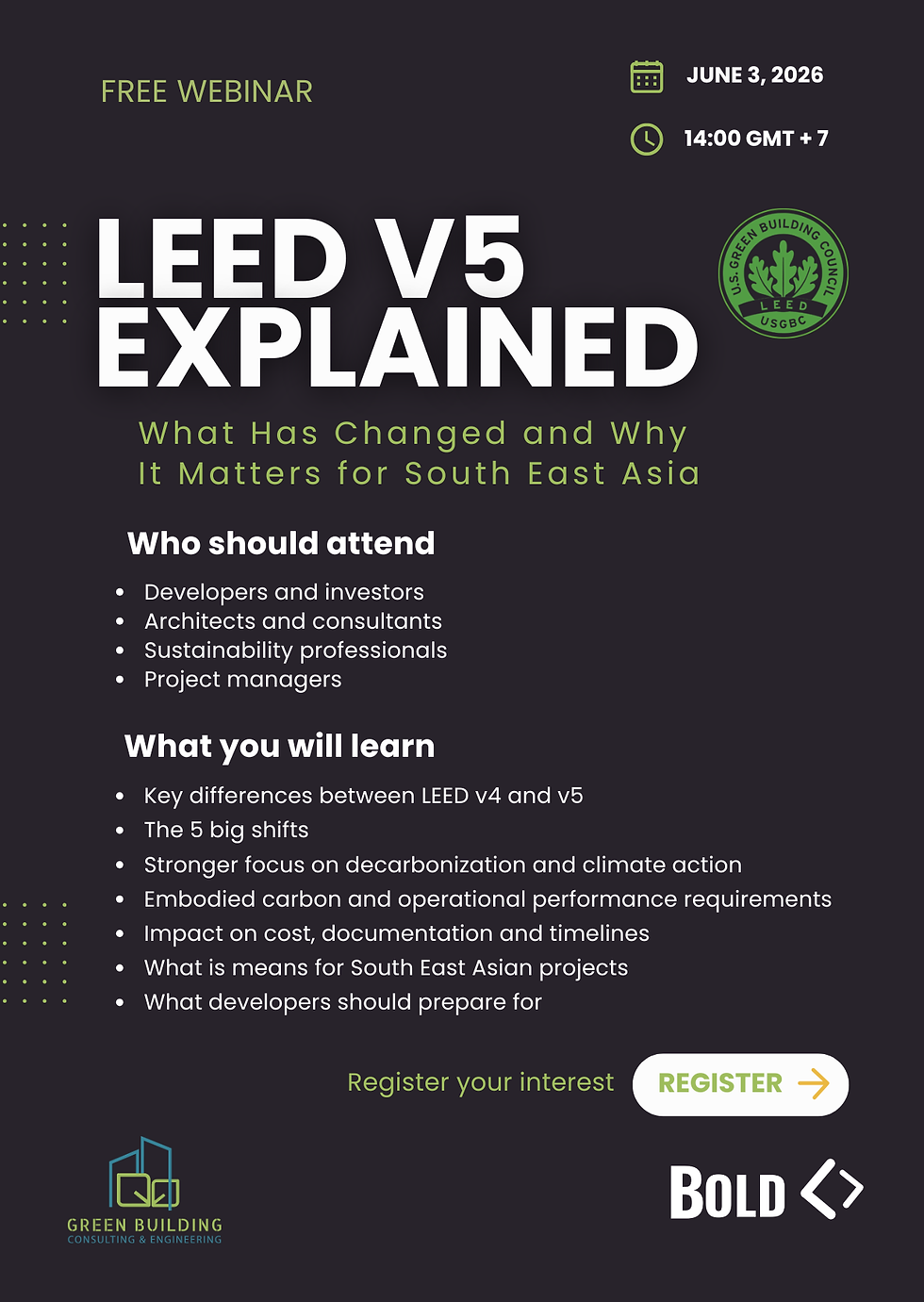
What the June 30 Deadline Means for South East Asian Project Teams
Starting on July 1, 2026, LEED v5 will be the only version available for new registrations for the commercial LEED BD+C, ID+C, and O+M rating systems, with limited exceptions. U.S. Green Building Council
Projects that register under LEED v4 or v4.1 before the June 30, 2026 deadline will have until the certification sunset date of June 30, 2032 to complete certification. That is six years to complete documentation and submit for review under the familiar framework. UL Solutions
This matters for South East Asian project teams in three specific situations.
First, projects currently in early design or feasibility that have not yet registered. If certification under LEED v4.1 is the intent, the team has until June 30 to register. After that date, v4.1 is no longer available.
Second, projects that have registered but have not yet fully engaged their consultant team. Registration alone is not enough. Teams need to ensure their documentation strategy, energy modelling scope, and materials specification approach are aligned with whichever version they have registered under.
Third, projects that are undecided on whether to pursue certification at all. If a developer is weighing the question, the deadline forces a decision. Waiting past June 30 means accepting v5 requirements, including the embodied carbon prerequisites, the resilience assessment framework, and the expanded decarbonization requirements
What to Do Before June 30
For any South East Asian project team with an active certification decision, these are the steps that matter in the weeks ahead.
STEP1: Confirm your registration status. If you have not registered and intend to pursue v4.1, June 30 is your hard deadline. Registration can be completed through the USGBC's LEED Online platform. Basic project information including location and address must be provided at registration.
STEP2: If you are considering v5, begin the gap analysis now. Understand which prerequisites are new, what life cycle assessment scope is required, and whether your design team has the capability or needs additional support.
STEP3: Review your materials specification strategy. Under v5, embodied carbon tracking for structural, enclosure, and hardscape materials is a prerequisite. This requires material takeoffs and Environmental Product Declarations from product manufacturers. Starting this conversation with your contractor and structural engineer early significantly reduces cost and effort later.
STEP4: Engage a LEED consultant who is familiar with v5. The documentation requirements under v5 are different in structure and scope from v4.1. Teams that approach v5 with v4.1 habits are likely to find gaps at review stage that are expensive to resolve.
South East Asian Project teams across global markets are operating at an interesting moment.
Governments in multiple regions are tightening building energy requirements, and investor demand for demonstrable sustainability performance in commercial and mixed-use assets is growing. Green building certification, whether LEED, EDGE, or another framework, is shifting from a premium differentiator toward a baseline expectation for institutional-grade assets.
LEED v5's emphasis on decarbonization, embodied carbon, and ecological performance reflects the direction of travel for green finance frameworks, corporate occupier requirements, and the regulatory environment across many markets.
Sources
USGBC, LEED v5 Official Page: usgbc.org/leed/v5
USGBC, LEED Certification Deadlines: usgbc.org/tools/leed-certification/deadlines
USGBC Support, LEED v5 FAQ: support.usgbc.org
UL Solutions, What to Know About LEED v5, 2026
Steven Winter Associates, LEED v5 Decarbonization Requirements, May 2025
Steven Winter Associates, LEED v5 and Embodied Carbon, May 2025
One Click LCA, LEED v5 Launches with a Focus on LCA and Embodied Carbon, April 2025
Green Badger, LEED v5 Updates for General Contractors, July 2025
BuildingGreen, LEED v5 Is Here, July 2025


Great article with useful insights. I recently started playing more PvP games and wanted to know if my clicking speed was holding me back. I found this CPS Test Online. It helps measure your clicks in a timed session, lets you compare scores from different attempts, and gives you a simple way to track improvement while practicing regularly.